Discipline: Amuro

  • AG

    After the honeymoon, I now had to fight reality — I couldn’t keep living as some punk nobody forever.
    Miyoung saw potential in me.
    “Oppa! What can you actually do?”
    “Me? Recording, guitar, drums, bass, um… watercolor?”
    “Not that — is there anything you can do at an actual company?”
    “I did web design up until last year.”
    “Oh yeah? Anything else?”
    “I know a bit of Flash too.”
    “Oh yeah? That’ll do.”

    From that day on, Miyoung started firing off resumes by the dozens, padding out my thin portfolio by quietly slipping in some of her own work.
    I went around to interview after interview, and eventually a company near Hongdae called Elluo got in touch.
    I interviewed and started working that same day — spent about a month building a full-Flash luxury apartment promotion site.
    Pulled all-nighters every single day.
    I’d only ever built menus before — this was my first time doing a whole full-Flash site, which was the trend back then, and collaborating with other people on that side of things felt awkward.
    Then one day, while I was at the office, I got a call.
    “Hi, this is Ahn Graphics — AG.”
    “Sorry, An- an- what?”
    “Ahn Graphics. You passed the resume screening, so come in for an interview.”
    “Uh — uh — okay.”
    What is this?
    I called Miyoung.
    “Miyoung, some place called An-something-graphics wants me to come in for an interview?”
    “Wait, seriously?? Oh my god oh my god holy shit, oppa, you’re the best.”
    “I have no idea what’s going on.”
    “Just take a half day off tomorrow and go to that interview.”
    “Uh — uh — okay.”

    The next day I threw on a jacket and went for the interview at a building with
    “AG”
    on it, at the foot of a hill in Seongbuk-dong.
    The neighborhood was really nice — and one I already knew.
    Suyeon used to live there, and before that Hyeokchan-hyung and Jeongju-noona had rented some falling-apart house up on the hilltop there.
    I knew Ssangdari truck-drivers’ diner well too, and Eommason Kalguksu looked familiar.

    Interview room.
    Wonseok-hyung, Changhee-hyung, and a row of other senior staff were sitting there, and while I was walking through my portfolio, I suddenly remembered a web scheduler prototype I’d been building that I’d forgotten to put in — and I wanted to show it to them.
    It didn’t even have a domain yet and I couldn’t remember the address, so I asked for a moment, pulled up my email, and searched for it.
    Everyone lost it.
    I mean, there’s comedy, and then there was this.
    I closed my portfolio slides and pulled up my inbox — and my sent folder came up right there on the giant interview-room projector, in full view.
    “Applying for the ActionScript position — Lee Donghoon”
    “Applying for the ActionScript position — Lee Donghoon”
    “Applying for the ActionScript position — Lee Donghoon”
    “Applying for the ActionScript position — Lee Donghoon”
    “Applying for the ActionScript position — Lee Donghoon”
    An entire page, wallpapered end to end with my own job application emails.
    I scrambled to close the window, and of course the close button was nowhere to be found — total meltdown, stammering, panic.
    “It’s fine, it’s fine. Take your time”
    — everyone was barely holding back laughter.
    Either way, I gave it everything I had, and a few days later they called asking when I could start.
    Miyoung was over the moon — she said AG was the oldest, most prestigious agency in Korea, a place she’d tried to get into herself and always failed.
    Later on, drinking with the senior staff, they told me the web scheduler I’d shown them at the very end had actually left a real impression.

    AG brought me huge challenges.
    Good content, good designers, good planners, a good environment — all of it lining up together, and I worked through countless projects there.
    It was the first place that made stepping into the digital field actually feel worth doing.
  • Miyoung

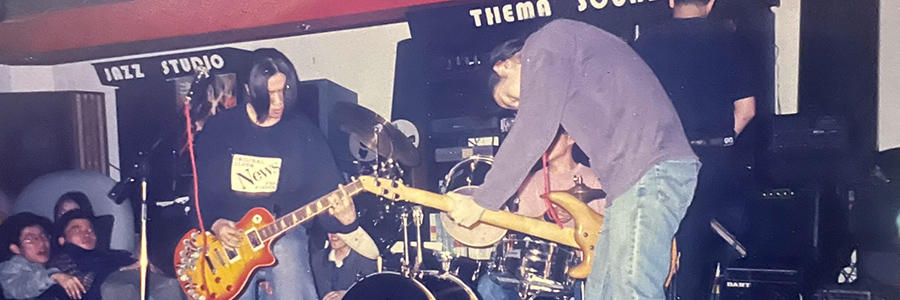
    One day in late summer, I heard someone was playing a show at Rolling Hall in Hongdae and went out to check it out.
    I was chatting with a friend about this and that when something at the edge of my downward line of sight kept nagging at me, so I looked down.
    There was some small, pretty girl crouched down smoking a cigarette, and when I looked down at her she looked up at me and — whether it was because of me or the sunlight — scrunched up her face and said something I don’t really remember.
    All that stuck with me was a vague, intense impression, and then I forgot about it.
    The following summer, the moment I finished paying off the debt to Moonhee, I quit GST — handed the practice room off to a junior, and moved into a rooftop room in Gwangheungchang.
    I’d been at GST a year and a half, and my plan was to stretch the 5 million won severance payout over a year or two.
    Since the rooftop room had been paid for out of the money from clearing out the practice room, I had no rent to worry about, so as long as I didn’t go out drinking and acting like an idiot, it was plenty.
    That summer was brutally hot, and the rooftop room was basically a sauna.
    I’d soak about ten towels in water, fold them into brick shapes, and stack them neatly in the freezer.
    Around 5pm, once the radiant heat really started pouring in, I’d pull one frozen towel out and unfold it — it’d crack open, still holding its shape, into a wide towel-sized sheet.
    Take your shirt off, drape it over your shoulders, and the heat would back off for a while.
    You had to run the fan on low with it, though — on high it’d just drag hot air along with it and cut the effect in half.

    I was holed up in that rooftop room studying JSP and Flash more seriously, investing in myself for whatever my next way of making a living would turn out to be, whenever that ended up happening.
    One night I got a call from Sharon.
    What are you doing?
    Studying.
    I’m coming over.
    No.
    About an hour later, the iron stairs up to the rooftop went clanging and banging.
    Ugh — I told her not to come.
    Sharon, Yeongran, and some girl I didn’t know showed up at my door completely wasted, each holding a plastic bag stuffed with a few bottles of soju and beer.
    The drinking went on for a while.
    Sharon and Yeongran passed out, and I ended up talking with the girl I didn’t know until almost morning — the two of us eventually fell asleep in front of the kitchen.
    That winter, after a show wrapped up and we were at the afterparty, that same girl showed up.
    We drank together for a while and went our separate ways.
    She said she still had my drumstick bag and asked when the next show was.
    After that she started coming up to the rooftop a lot.
    It felt like a lot of pressure.
    I was in the middle of studying, and I figured it was an important stretch of my life, so I wanted to cut back on drinking and going out — and honestly I had no money either, and wasn’t in any headspace for a relationship.
    When I kept telling her to stop coming by so much, she started talking mutual friends of ours into it instead, showing up with 7 or 8 people at a time.
    There was no turning them away once they showed up loaded down with samgyeopsal.
    Ugh.
    Am I getting dragged into this again?
    One morning, the guys who’d all crashed at my place started peeling off one by one to head home, until it was just her and me left.
    I told her straight: don’t come anymore!
    She left.
    That same night, the iron stairs went clanging and banging again.
    It was her.
    Both hands full — suitcases.
    And that’s how we ended up living together.
    Still are, to this day.
    My wife, Miyoung.

  • Half brothers

    I met Bongguk in the same major at Hakshow.
    We just clicked.
    He was a pretty skilled skateboarder, actually had a name for himself in that scene, and thanks to him I got into skateboarding too, and got exposed to that whole side of music.
    Not long before I went into the army, we started a band together, and it was genuinely great.
    After I got an early discharge from the army, we got back in touch and made it official.
    Jongwook-hyung joined on drums.
    We were all in the studio watching a snowboarding video one day, and a song in the soundtrack titled
    “Brothers from Different Mother”
    inspired the band name — Half Brothers.
    Within just a few months we’d written a dozen or so songs together and started making the rounds of Hongdae, auditioning wherever we could find a place to play.
    There was a club near a subway station — could we play every Wednesday?
    Pay was unlimited beer plus 5,000 won cash.
    We played there with other bands for a few months, though honestly there were so few people there it felt embarrassing to even take that 5,000 won.
    We’d just watch each other’s sets, cheer each other on, drink flat free beer, and hang around goofing off, then head back to the studio for a round of soju and talk through the night.

    Around then, Lee Sungwoo from No Brain reached out and asked if we wanted to join a label called Munhwasagidan (Culture Con Artists).
    No reason on earth to say no.
    Shows Munhwasagidan put on would still pull in around a hundred people — I got my first real taste of the thrill of being onstage, we started touring outside Seoul, and life took on that broke-but-somehow-vibey shape you’d expect from an indie band.
    Then Jongwook-hyung went missing.
    Seokyul — now the vocalist of Kingston Rudieska — moved to bass, and I moved to drums.
    Later, Haewon (drummer from Beach Valley) joined on guitar, Myeonggwon joined too, and I moved back to bass.
    We released a split single and kept going.
    Right around when I would’ve called it smooth sailing, Rage Bone stole Haewon from us.
    Bastards.
    Genuinely, actual bastards.
    No matter how powerless or unknown a band is, poaching someone else’s member like that makes you a bastard, full stop.
    Anyway, I moved back to drums, but something wasn’t the same anymore — some kind of drive had drained out of me, and I just lost steam.

    They say everything comes down to timing. The band, which had been limping along in a half-hearted state for years by that point, suddenly got a jolt when Bongguk snapped out of it right around when I was getting married — he was suddenly thrashing to make it work for real. And, wouldn’t you know it, that was exactly when I became unable to meet that expectation.
    Such is the life of a married man, hahaha.
    Miyoung and Bongguk fought over it for a long stretch too. From Bongguk’s side, he felt like Miyoung had stolen me away; from Miyoung’s side, she felt like Bongguk had been the one hogging me.
    The popularity of one man, hahaha.
    It took the two of them more than ten years to patch things up, and around that same time I left the band.
    I went through plenty of bands one way or another after that — some more fun, some more exciting, some more profound — but Half Brothers was, I don’t know, just me. Myself, distilled.

    This year, late summer 2026, Bongguk came to visit Australia with his best friend Eunbyeol. We’ve all gotten old.

  • Year one in Hongdae Universe.

    Year one in Hongdae Universe.

    For the first time in a long while, I found myself rolling around on the ground.
    It was the day my college entrance exam results came out.
    I was so happy I rolled and rolled and kept rolling.
    It felt like I’d already become an artist.
    A month, two months went by after I started, and it didn’t take long for that dreamlike feeling to fade.
    Classes were boring, and even as a first-year I was already seeing guys angling to line up with the TA-professor track, and I started seeing the whole rotten system of the art industry, or at least this corner of it.
    Looking back now, sure, everyone’s just trying to make a living — but back then, maybe because I was so soaked in punk spirit, that kind of system disgusted me even more, and having already been badly burned once by the church system made it worse.
    I was young.
    That’s just how it was back then — I was right, you were wrong.
    Whatever it was, I was the center of it.
    Anyway, I still had to graduate, so I’d show up near school and log my attendance, but I basically gave up on any real intention of actually painting.
    If I hated the system that much I should’ve just dropped out, but I guess I couldn’t let go of the diploma, since I stuck around and graduated anyway — which says something pretty two-faced and shabby about the kind of person I am.

    The moment I started college, I began teaching watercolor to kids at Saramdeul Art Academy.
    Four hours a day, three days a week, which came out to 360,000 won a month.
    The next year it was 600,000, the year after that 900,000.
    My mom told me to put 300,000 won a month into a five-year savings plan.
    I said, are you crazy, then what am I supposed to live on?
    We argued for a bit, and then she said,
    “I’ll chip in 150,000 won a month for the first year.”
    Really?
    Okay, hmm, let me think about it, haha.
    Anyway, that savings plan would, a few years later, become my very first studio and recording space.
    Around the end of my first year, some classmates and I started a Nirvana cover band.
    During winter break we set up a drum kit and a couple of cheap little amps in the empty studio room and had a blast.
    It was so cold that if you bought a can of vending-machine coffee, it’d turn to ice within an hour.
    We played a set at a department event, and overall it turned into a pretty good memory.

    When I say
    “kids,”
    I really just mean students one or two years younger than me, or even the same age.
    The idea that I was teaching other people just because I’d started school a year earlier made me feel a little full of myself, I think — and I guess I was also genuinely starting to enjoy teaching, in my own way.

  • Jump into painting

    Jump into painting

    I was always somewhere around first or second in my class, and I guess I could draw pretty well too.
    What are you going to be?
    That question was slowly turning into something real.
    As a kid, sure, you just blurt out whatever — a scientist! the president! an astronaut!
    But now it was starting to actually collide with reality.
    What was I going to do?
    Physics, chemistry, biology, earth science — I always found those fun.
    Korean, English, math were unbearably boring.
    So, science, maybe?
    Except that meant going the science track, which required Math I and Math II as mandatory subjects.
    While I was going back and forth on all this, my art teacher came up to me and asked,
    “Want to try drawing?”
    I thought, what kind of nonsense is this — but by the time I got home and thought it over, it actually started to make sense.
    Designer?
    Painter?
    Sounded kind of cool, thinking about it.
    Plus it was humanities track — just regular math required.
    So I enrolled at the art academy a close friend was already going to.
    It was about a 30-minute bus ride, and looking back, it was good in all sorts of ways — getting to know a new neighborhood on the way, meeting new friends, and as a bonus, the art academy was full of pretty girls.
    Do pretty girls go into art, or does art make you pretty?
    Either way, it wasn’t a bad deal.
    I had a consultation with the academy director, who said I studied well and had decent fundamentals, so let’s aim for Hongik.
    There were eleven departments — Industrial Design, Visual Design, Printmaking, Sculpture, Oriental Painting, Ceramics, Painting — and Painting looked coolest to me, so I set my sights there, and my life at the Sadang-dong academy began.
    It wasn’t the cool, painting-focused academy life I’d imagined, though.
    Every single day was grinding out sketches and watercolors to fit the entrance-exam rubric.
    My shoulders ached like they were about to fall off, my eyes were tired enough to pop out of my head, day after day.
    But alongside that came a chance to enjoy a bit of rebellion too — the art kids apparently had good taste in music as well, so we traded good tips and good songs, and before I knew it exam season was on top of us.
    I poured over twelve hours a day into the academy, prepared as thoroughly as I could.
    The results were brutal, though.
    I applied to three schools — Sejong University, Chung-Ang University, and Hongik University — and only got an acceptance letter from Sejong.
    Rejected everywhere else.

    The following year I switched academies to one in Hongdae called Saramdeul Art Academy.
    My thinking was that to actually get into Hongik, I needed to quickly absorb whatever the latest trends were at the academies near campus.
    But that opened a Pandora’s box.
    In 1995, Hongdae was genuinely an up-and-coming, exploding hip neighborhood.
    I’d wander around to live shows, and there was even a café that played MTV videos all day long — something that was hard to come by back then.
    I needed more academic study too, so I enrolled at a place in Noryangjin called Jeil Academy, known for being brutal but effective for retaking the exam.
    It was a prison, plain and simple.
    The academy was a five-story building completely wrapped in iron bars, and once you walked in in the morning, you couldn’t leave until it let out at 5.
    There was a girl there I’d occasionally lock eyes with, and it didn’t feel bad.
    Who is this bold, blank-slate kind of girl?
    Eh, probably nothing, whatever.
    Honestly, up to that point I’d never had a girlfriend and never even seriously thought about it — I’d definitely thought about approaching girls countless times, but I never had the confidence, and that petty fear of getting rejected never once gave me the courage to make the first move.
    We’d talk here and there, and since her academy happened to be just three buildings down from mine, we’d sometimes walk together after study hours on our way to the art academy.
    One morning I got to the academy and she was slumped over her desk asleep, eyes completely hollow.
    At lunch, she came up to me.
    “It’s your birthday, right?”
    “Huh? Oh — is it?”
    “Here, take this.”
    It was a T-shirt.
    I unfolded it.
    Something was off.
    It was a Nirvana shirt, but Kurt’s face and the band’s logo were bumpy, textured.
    Huh, I thought, do they even have printing tech like this these days?
    “Wow, thanks — when’s your birthday?”
    — in my awkwardness, that’s what came out of me.
    When’s your birthday.
    God, what a clueless idiot.
    I looked at the shirt more closely.
    Wait.
    Wait, what?
    It was drawn.
    It had actually been drawn by hand.
    She said she’d stayed up all night drawing it.
    What the hell — how?
    Why me?
    Was this girl even in her right mind?
    That evening we had soju together.
    We went to Woodstock in Sinchon, had a bit more beer, and walked out.
    We ended up walking across Mapo Bridge.
    It was pouring rain, hard, for a long time.
    We were soaked through.
    Neither of us cared.
    It was early morning by the time we made it to Sindaebang.
    One more stop and we’d be at her place, but our legs were aching, so we got on the subway — not too crowded yet.
    Sillim Station.
    I was supposed to get off.
    I didn’t want to.
    I let it pass.
    We kept talking a bit more, and I think I dozed off.
    When I woke up, we were back at Sindaebang.
    We ended up circling Line 2 twice like that before I finally walked her home, then walked back myself.
    My steps were light, and everyone heading to work looked happy.
    I got smacked on the back by my mom, showered, ate breakfast, and headed off to the academy.
    That was the start of my very first relationship — with Hyoseon.

  • Rock ‘n Roll Highschool

    Rock ‘n Roll Highschool

    The neighborhood kids I’d gone through elementary school with started going to church.
    I held out against it as long as I could, but once the weekends rolled around and all of them were off at church, I didn’t have much of a choice.
    So I went.
    Church.
    There was a pretty girl there.
    I kept going.
    And that’s how my middle and high school years came down to: church life.
    I gave it everything — I wanted to look good, wanted to matter.
    I drew the whole church bulletin myself, started playing guitar for the service, and for Christmas and Easter I did the stage decorations, the banners, all of it.
    I turned into one of the church’s go-to guys, got folded into it, absorbed into it.
    Salvation?
    Jesus?
    None of that was really the point, honestly.
    It was just my first real community, my main stage.

    Learning guitar opened up the range of music I was listening to.
    I got possessed by Queen.
    I fell in love with the Beatles.
    Starting from the classics — Sepultura, Slayer, Ozzy Osbourne, Led Zeppelin, Jimi Hendrix — and once I found Nirvana, Mudhoney, and Meat Puppets, I started actively hunting down punk.
    A whole new world had suddenly cracked open.
    There was too much music to listen to, and every new discovery hit like a shockwave — because I was a teenager, and completely empty, ready to take in anything.
    Well, along with all that, my ego started swelling too.
    Puberty?
    I don’t think I really had one of those.
    Trouble-making?
    Whatever promise I’d made to my dad the night before starting elementary school — that never wavered.

    It was Christmas Eve, around when I was 17.
    I’d edited together about 25 Christmas carols into a medley, splicing short pieces of each one together, printed up the sheet music — everything was going smoothly.
    Then the pastor stepped in.
    Cut every carol that mentions Santa, he said.
    Okay, so 25 songs becomes 7, and all that’s left are the droopy, slow ones?
    I went ahead with my version anyway, and got chewed out for it, and honestly I didn’t even understand why at the time.
    Later, when I looked into it, the logic was apparently something like: Santa has nothing to do with the birth of Jesus, so why sing about him at Christmas?
    Something like that.
    And then that same pastor started trashing Queen.
    My Queen.
    Called it the devil’s music.
    Because Freddie was gay?
    Probably.
    Made sense, in a way, once I understood this was an organization that judged things by that kind of narrow-minded yardstick — of course Santa got trashed too.

    One day I went to the church early in the morning for something, and caught the pastor chasing off a homeless person.
    Hm — maybe it was just my ego getting bigger, but I stopped being able to swallow everything at face value, and questions started piling up.
    This organization exists for itself.
    This is a business too.
    I was never interested in Jesus, but I’d at least assumed the church was a place free of prejudice, out in front doing good — and then, in one single moment, everything I’d poured into it through middle and high school just collapsed.
    Suddenly the whole institution looked filthy to me — something I couldn’t see while I was still standing at its center.
    That’s how my first community disappeared.

  • Home

    Squad 7 had about 30 men.
    But something felt off right away.
    I’d always pictured the army as guys with sun-bronzed skin radiating raw energy, but when I walked into the barracks, there was no formal check-in, nothing — everyone was just asleep.
    Someone told me to take a bunk and sleep too, so I lay down in a daze, but I couldn’t.
    Around 8pm, another dozen or so guys walked in fully armed and geared up, quietly took their gear off, and went straight to sleep.
    What on earth was going on here.
    Around 1am, the lights in the barracks came on and I saw everyone’s faces for the first time — all pale.
    That’s when it clicked: this was a sentry unit.
    No roll call, no exercise, no training — just eat, go out on guard duty around the clock regardless of day or night, come back, eat, sleep.
    The only time everyone was actually awake at once was maybe 3 to 6pm.
    At 6, the night-shift guys would eat and head out; when they came back around 2am, the morning-shift guys would take over.
    That was the whole rhythm.

    Anyway — each time I went out, I’d spend eight or nine hours in a tiny bunker overnight, killing time with a boring senior soldier while listening to the waves and staring at a pitch-black sea.
    Over three or four months, I went on exactly one run and played soccer exactly once.

    I didn’t really mind any of it — I tried to do everything well, and I did.
    I never got called any of the usual army curse words, never got a punch thrown at me, not even a slap.
    The perfect soldier.
    The soldier nobody could pick on.
    The soldier who just handled things on his own.
    But that very perfection became a cage I locked myself in, and I started coming apart inside it, slowly.
    A compulsion started closing in on me — you have to do well, you can’t make a mistake, you can’t disappoint anyone — and being stuck in a space where, after telling myself
    “good job today,”
    there was nothing I could actually give myself as a reward, started driving me out of my mind.

    No matter how hard the work was, no matter how badly I got treated, I could put up with any of it — as long as I had the power to walk away whenever I wanted.
    But the army, as an institution, allowed for no such thing, and there wasn’t even the smallest crack left in my mind, no room left to breathe.
    Living as an isolated platoon, cut off from the larger unit, didn’t help either.
    There was a private first class who worked as the cook — a sergeant beat him with a shovel so badly the right side of his face was nearly caved in, and the platoon leader and assistant platoon leader both just kept quiet about it.
    If something like that got reported, it would hurt their own promotions — that must have been it, because otherwise they’d have gotten him to a hospital.

    On top of everything, my girlfriend had stopped writing to me.
    Then one night, as the weather was turning warm, I broke.
    I clawed at my own face with a razor blade and slammed my forehead into the wall as hard as I could.
    Why did I do it — was I trying to die?
    I don’t think so.
    If I’d wanted to die, I would have cut deeper and hit the wall harder.
    I didn’t want to die.
    What was it, then — some kind of protest, in my own way, I suppose: send me somewhere else, send me home.
    Not that it was ever going to work.
    Either way, the assistant platoon leader hauled me onto his back and carried me to company headquarters.
    The company commander looked at me, and — I have no idea what he was actually thinking — but from his face it was something like: this idiot went and did something, what the hell happened, Amuro, you okay?
    Damn it, there goes my promotion.
    I can’t really know what was going on in his head, but he laid me down on a bed and stepped outside to make phone call after phone call.
    Even with everything going on, somehow I needed to pee.
    Well, I needed to pee, what could I do about it — getting up and walking to the bathroom in that moment felt absurd, so I just wet myself where I lay.
    The company commander came back in.
    You little shit — if someone ends up like this, you send them to a hospital first, and instead he was trying to cover it up and manage it quietly.
    Either way, he started hitting me — I think I took something like 40 or 50 slaps across the face.
    And the next day, they put me in the psychiatric ward at the Gangneung Armed Forces Hospital.

    The psychiatric ward is a sad and funny place, all at once.
    Real drama unfolds there — no sitcom I’ve ever seen compares, and no thriller either.
    I spent two months there, and eventually came home due to
    “unstable brain waves.”

  • Army

    On October 23rd, 1998, I headed for Nonsan.
    What’s in Nonsan, you ask?
    Boot camp.
    The first night was kind of strange — lying there on the floor, I remember thinking, what is this exactly?
    Is this the army?
    Is this camping?
    Some kind of school retreat?
    I lay there wide-eyed, turning it over in my head, when — bugle call, that classic wake-up melody — I snapped awake.
    Whoa, make your bed and fall in within five minutes, and suddenly I’m running laps around the field.
    Blink, and two weeks had passed, and I’m firing an M16.
    Blink again, and I’m on a 40km march in full combat gear.

    Boot camp was a no-smoking zone, and by around day 10 the withdrawal symptoms were hitting me hard.
    One day, while we were moving somewhere, I spotted a long cigarette butt on the ground and snatched it up fast.
    Feeling around in my pocket, I could tell — just filter and paper, the tobacco inside was empty.
    Like someone had pinched the cigarette out with their fingers, except instead of the whole middle section coming out, only the burning tip and the loose tobacco had gone with it, leaving the paper tube intact.
    That’s what I’d picked up.
    From that day on, my hobby was collecting butts.
    About one a day, and once I had a dozen or so, I’d go to the bathroom and start reassembling them — pulling the tobacco out of each butt and packing it into one long empty tube, carefully, so the paper wouldn’t tear.
    Eventually I had one complete cigarette in my hand, plus two co-conspirators, who’d earned their spot in this project by virtue of owning a lighter.
    The three of us took our long, glorious drags to savor the moment — and hacked and coughed, because there was no taste at all.
    Just the flavor of smoking a dead leaf.
    I mean, come on, how anticlimactic can you get.
    I only learned chemistry from a textbook, so sure, fine — but somebody should have mentioned in chemistry class that tobacco exposed to open air that long stops being tobacco.

    Then one day, on our way to a religious service, I saw one of the drill instructors flick his cigarette and toss it on the road — and this one felt different.
    This guy’s an amateur.
    The still-lit butt tumbled through the air in slow motion and hit the bathroom wall before dropping to the ground.
    I looked around, and there was a buddy of mine, and we locked eyes with the exact same glimmer — no plan, no words exchanged, we just naturally peeled off from formation, grabbed the butt, took one long drag each, and slipped back into formation without anyone noticing.
    This time, I didn’t breathe out right away.
    I held the smoke, pulled it as deep into my lungs as I could on the inhale, then held my breath again.
    Almost nothing came back out on the exhale.
    Even every single cell in my lungs seemed to be rooting for me — and it wasn’t just in my head.
    I could feel the whole process: absorbed in the lungs, dissolved into the blood, pumped back out through the heart to the whole body, delivered through the capillaries all the way to my fingertips.
    I’ve quit and started again more times than I can count since then, but nothing has ever hit as hard as that one did.

    A few days before boot camp graduation, they gathered everyone to pick out soldiers with special skills.
    When they called for bass players, I shot my hand up and ripped through Rancid’s
    “Maxwell Murder.”
    A few days later, half-nervous, half-excited, I went to where they were announcing the assignments.
    Da-da-da-dum~ Trainee number 176!
    Drumroll….
    Mortar squad!
    Well, damn.
    A punk band in the military — of course they had no spot for me.
    My mistake for getting my hopes up in the first place.
    And so for another four weeks, I hauled a 17kg mortar base plate on my back across one hill after another, digging holes, and then digging some more.

    I boarded a train at Nonsan Station — the day I’d be heading to my actual unit.
    I had no idea where I was going.
    The train stopped here and there, people getting off along the way, and by the time I noticed, it was night.
    A familiar skyline came into view.
    Seoul.
    Could it be — the 17th Division — nicknamed the
    “Tang Dynasty unit,”
    army slang for an outfit with basically no discipline?
    The Capital Defense Command?
    Paju?
    My head was full of every hopeful scenario imaginable when we got off at Cheongnyangni.
    At that point I was still convinced it’d be the Capital Defense Command, or Uijeongbu at worst — but they fed us some strange boxed lunch and put us right back on a train.
    The train stopped in Wonju.
    We spent three days at some unit there, then got loaded onto a bus, crossing mountains and rivers, stopping here and there to let people off, until it was just me and one other guy who looked kind of dazed.
    We spent one more night at yet another unit, and left early the next morning.
    The bus wound its way over a few hills, and after the last, biggest ridge, the East Sea suddenly opened up in front of us, sunlight pouring down over the water.
    Whoa — is this it?
    Is this really it?
    The unit sat on a high bluff at the edge of Yeongjin Harbor — Yeongdeok and Jumunjin up the coast, Sacheon below, and Gangneung visible way off in the distance.
    I loved the sea — in fact, just a month or two earlier I’d taken a bus alone at dawn to that same stretch of coast near Sacheon.
    But the next day, my platoon got assigned, and I ended up in the place everyone called
    “7”
    — and the moment I saw my seniors there, I knew something was wrong.

  • Smell

    I couldn’t smell from the day I was born.
    I just grew up thinking that was normal — it never really bothered me.
    If something gets taken away from you, sure, that’s sad and unfair, but if you never had it to begin with, you don’t even know what you’re missing, so you just live with it.
    Especially when it’s not like I was missing arms or legs, or couldn’t see — it was just smell.
    Still, my parents took me to the hospital from early on, hoping the sensor might somehow recover, or that clearing out the sinusitis might open the passage and let me start smelling things.
    From their side, it must have been heartbreaking.
    When I was around 12, the hospital said: let’s do the surgery when you turn 19.
    Do it too young, they said, and the bone could deform — better to wait until you’re fully grown.

    I turned 19.
    I’m sitting in a hospital room talking with the doctor.
    Since you’re young, he says, let’s skip general anesthesia and just do local — you can tough it out.
    How bad could the pain really be, he says, it’s only about 20 minutes.
    Fine, I say.
    Surgery day.
    I walk into the operating room wide awake.
    Doctor 1, Doctor 2, Nurse 1, Nurse 2, Nurse 3.
    Doctor 1 comes over with a syringe and injects anesthetic somewhere inside my mouth and nose, and then all these instruments come into view — who wouldn’t be scared?
    But I’m Amuro.
    Nineteen years old, in my prime, Amuro.
    When the first instrument goes into my nose and gently touches somewhere on the inner wall, I think: oh, so this is what it feels like, not so bad.
    That confidence doesn’t last 30 seconds.
    The scraping, the cutting — it stops being just sound and starts coming through as sensation.
    Wait, is this thing even numb?
    The feeling is that vivid, and the pain is beyond words.
    Somewhere deep in my pride, me and my nervous system’s survival instinct start fighting it out for real.
    Tell them to stop?
    Are you insane?
    You’re a man.
    The surgery drags on for about two hours, and all I can think about is slitting Doctor 2’s throat.
    Everything I’d heard in the pre-op briefing is now vivid enough that even I — not just the doctor — can follow along in real time.
    There’s a vertical partition inside the nasal cavity of the skull, and mine had been bent out of shape from years of trapped pus; the plan was to drain the pus, cut into the partition and the muscle beside it, stitch it back up, and let the muscle contract as it healed to pull the partition straight again.
    And yeah — I can tell exactly what’s happening.
    Now they’re cutting the partition.
    Now Doctor 2 slips and cuts into the wrong muscle next to it.
    You bastard….
    You bastard…
    You bastard…
    All I can do is clench my fists and repeat that, over and over.

    I stayed in the hospital for five days after the surgery, and when I came back ten days later,
    “you bastard”
    slipped out of me again.
    The doctor asks: so, can you smell now?
    Yes?
    No.

    Life is funny like that — around the time I was supposed to head off to the military, I heard that if you couldn’t smell, you might not have to go.
    But no hospital could actually prove that you couldn’t smell.
    It was a loophole in an unreliable system that depended entirely on your own say-so.
    Made sense, in a way — if every man in Korea could just say
    “I can’t smell,”
    nobody would ever have to serve.
    Can’t smell, don’t have to go — but there’s no one who can prove it.
    The end!

    When I turned 21, there was a general hospital called Samsung Medical Center, founded by Samsung, and one of the ENT department heads there had earned his doctorate — and become quite famous — for developing an objective way to prove someone couldn’t smell.
    The day I went in for my appointment, they had this whole elaborate setup ready for me.
    For four hours I tasted sample after sample — salty water, slightly less salty, even less salty, sweet water, slightly less sweet, even less sweet — thousands of little cups, checking boxes on a sheet after each one.
    The doctor said he’d invented the pattern himself, and that after tens of thousands of trials he’d statistically mapped out the typical response patterns of normal people, liars, and people who genuinely couldn’t smell — it couldn’t be fooled, he said.
    And so, on January 7th, 1998, I was officially certified as a person who couldn’t smell — and officially exempt from the military.
    My life plan was quietly rewriting itself into: a guy who doesn’t have to serve.

    Then in 1997, presidential candidate Lee Hoi-chang’s son got caught up in a draft-dodging scandal that blew up into a huge national issue, and starting January 1st, 1998, the military service law was revised — anyone who could function normally in daily life would now be drafted, smell or no smell.
    My draft notice arrived at the house.
    My appeal was denied.

  • Seoul

    Our house in the countryside had a pretty big backyard.
    One day my dad built a fence and brought home three deer.
    Two does and one buck — the buck was so skittish I barely ever saw it up close.
    From then on, I’d go up the mountain with my dad to cut kudzu vines to feed them.
    We’d cut off the buck’s antlers to sell, and I remember being horrified watching the neighborhood men catch the blood that dripped out and mix it into soju to drink.

    A few years later, the deer we’d bought for 5 million won had grown to be worth 15 million, and apparently that became the seed money for our move to Seoul.

    Seoul.
    Too many houses, too many people, too big a school — I’d become a Seoul kid.
    I’d only ever seen traffic lights and pedestrian overpasses in books, so they fascinated me — I’d raise my hand, wait for the light to turn green, cross, and then cross back again, over and over, more times than I could count.
    At my new school, introducing myself, I glanced around at the other kids — every single one of them had pale, pretty faces.
    No runny noses, no crusty eyes on anyone.

    I got paired up with a kid named Daeho, and we threw punches at each other every single recess.
    I don’t remember why at all.
    Daeho, Dohee, Jeongrae — I became friends with kids like that and went out to play with them every day.

    The adults kept saying things like the air in Seoul wasn’t good, that people were cold and distant — but to my eyes, nothing about it seemed wrong at all.
    The concrete pavement was actually more fun to play on than the muddy country roads, and I didn’t have to spend fifteen minutes running errands for my mom anymore — the store was right under our building, packed floor to ceiling with everything you could want.
    The toy section of the stationery store became a window-shopping destination that could hold me captive for hours.

    My mom started doing sewing work — making car seat covers.
    Our living room floor always had a mountain of car-seat fabric piled up.
    In the evenings, my older sister, Moonhee, and I would spend countless hours turning the triangular doll ears my mom had sewn right-side out, gently pushing the tips into shape with an awl.

    A year after we moved to Seoul, my mom made a decision that still sounds insane to me even now — she bought a house.
    60 million won, more than half of it a loan, and the interest rate on loans back then was something like 15 to 16 percent — practically loan-sharking.
    Looking back, that was probably the last window of opportunity, and my mom caught the very last train out.
    House prices doubled the following year, and to pay off the loan, my mom dug out the basement of the new house and built a sewing factory in it.
    When they excavated the ground, a 4-ton truck showed up, and a husband-and-wife pair hauled out all that dirt with nothing but two shovels between them.
    Just watching them, my own back ached.
    Two or three years later, my mom did an expansion, and the same couple came back — this time with a small excavator loaded on the back of the truck.
    Even to my young eyes, there was something that welled up in me watching that.
    I think that’s just what our parents’ generation was like — grinding their way up from the very bottom, one hard-packed step at a time.

    Dohee’s parents were rarely home.
    It was a rooftop unit with a wide roof deck, a ping-pong table up there, and one small room.
    I don’t think there was ever a better hideout for kids.
    By middle school, we’d still gather at that place — learning poker, swinging nunchucks around, covering Metallica’s
    “Enter Sandman,”
    and during breaks, working all day at Dohee’s dad’s factory stripping the insulation off wire ends for pocket money.
    Sometime around the middle of first year, I started walking to school with Gwangjin, who loved soccer, and we switched from taking the bus to running instead.
    It took about 30 to 40 minutes to get there, and I ended up with 120 won of bus fare money in my pocket every day.
    Someone from the local credit union came to school and made every student their own passbook — once a week, a class monitor would collect the money and get it stamped in the book.
    That 120 won piled up day after day, and by the time I graduated middle school, it had turned into a real sum: 150,000 won.
    With that money I was able to buy an acoustic guitar — a Fender, real or fake, I still don’t know — the one I’ve since handed down to my nephew Jinhyeong.

    Thanks to Slam Dunk, sometime around ninth grade, the school field emptied out completely.
    Everyone started playing basketball.
    On weekends we’d play from morning to night, all day long.
    Even when you were completely dying, slumped on the ground, someone would say
    “one more game?”
    and another one would just automatically start.
    God, I was young.