Discipline: Elementary School

  • Seoul

    Our house in the countryside had a pretty big backyard.
    One day my dad built a fence and brought home three deer.
    Two does and one buck — the buck was so skittish I barely ever saw it up close.
    From then on, I’d go up the mountain with my dad to cut kudzu vines to feed them.
    We’d cut off the buck’s antlers to sell, and I remember being horrified watching the neighborhood men catch the blood that dripped out and mix it into soju to drink.

    A few years later, the deer we’d bought for 5 million won had grown to be worth 15 million, and apparently that became the seed money for our move to Seoul.

    Seoul.
    Too many houses, too many people, too big a school — I’d become a Seoul kid.
    I’d only ever seen traffic lights and pedestrian overpasses in books, so they fascinated me — I’d raise my hand, wait for the light to turn green, cross, and then cross back again, over and over, more times than I could count.
    At my new school, introducing myself, I glanced around at the other kids — every single one of them had pale, pretty faces.
    No runny noses, no crusty eyes on anyone.

    I got paired up with a kid named Daeho, and we threw punches at each other every single recess.
    I don’t remember why at all.
    Daeho, Dohee, Jeongrae — I became friends with kids like that and went out to play with them every day.

    The adults kept saying things like the air in Seoul wasn’t good, that people were cold and distant — but to my eyes, nothing about it seemed wrong at all.
    The concrete pavement was actually more fun to play on than the muddy country roads, and I didn’t have to spend fifteen minutes running errands for my mom anymore — the store was right under our building, packed floor to ceiling with everything you could want.
    The toy section of the stationery store became a window-shopping destination that could hold me captive for hours.

    My mom started doing sewing work — making car seat covers.
    Our living room floor always had a mountain of car-seat fabric piled up.
    In the evenings, my older sister, Moonhee, and I would spend countless hours turning the triangular doll ears my mom had sewn right-side out, gently pushing the tips into shape with an awl.

    A year after we moved to Seoul, my mom made a decision that still sounds insane to me even now — she bought a house.
    60 million won, more than half of it a loan, and the interest rate on loans back then was something like 15 to 16 percent — practically loan-sharking.
    Looking back, that was probably the last window of opportunity, and my mom caught the very last train out.
    House prices doubled the following year, and to pay off the loan, my mom dug out the basement of the new house and built a sewing factory in it.
    When they excavated the ground, a 4-ton truck showed up, and a husband-and-wife pair hauled out all that dirt with nothing but two shovels between them.
    Just watching them, my own back ached.
    Two or three years later, my mom did an expansion, and the same couple came back — this time with a small excavator loaded on the back of the truck.
    Even to my young eyes, there was something that welled up in me watching that.
    I think that’s just what our parents’ generation was like — grinding their way up from the very bottom, one hard-packed step at a time.

    Dohee’s parents were rarely home.
    It was a rooftop unit with a wide roof deck, a ping-pong table up there, and one small room.
    I don’t think there was ever a better hideout for kids.
    By middle school, we’d still gather at that place — learning poker, swinging nunchucks around, covering Metallica’s
    “Enter Sandman,”
    and during breaks, working all day at Dohee’s dad’s factory stripping the insulation off wire ends for pocket money.
    Sometime around the middle of first year, I started walking to school with Gwangjin, who loved soccer, and we switched from taking the bus to running instead.
    It took about 30 to 40 minutes to get there, and I ended up with 120 won of bus fare money in my pocket every day.
    Someone from the local credit union came to school and made every student their own passbook — once a week, a class monitor would collect the money and get it stamped in the book.
    That 120 won piled up day after day, and by the time I graduated middle school, it had turned into a real sum: 150,000 won.
    With that money I was able to buy an acoustic guitar — a Fender, real or fake, I still don’t know — the one I’ve since handed down to my nephew Jinhyeong.

    Thanks to Slam Dunk, sometime around ninth grade, the school field emptied out completely.
    Everyone started playing basketball.
    On weekends we’d play from morning to night, all day long.
    Even when you were completely dying, slumped on the ground, someone would say
    “one more game?”
    and another one would just automatically start.
    God, I was young.
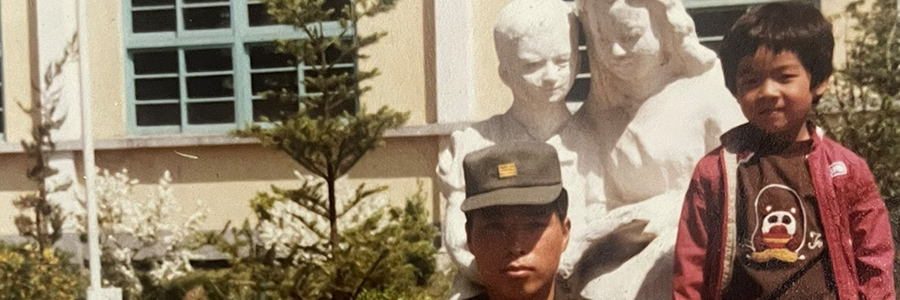
  • Elementary School

    Elementary School

    I finally made it into elementary school — after
    “flunking”
    a year of kindergarten first.

    The day before the entrance ceremony, I walked up to my dad — who was out in the yard sharpening a kitchen knife — and announced that from now on I wasn’t a little kid anymore, I was going to be an elementary schooler, and I’d act like one.
    Apparently I really did become a different person starting the very next day.
    I started elementary school.
    My homeroom teacher was an elderly, grandfatherly man who was especially fond of me.
    When I got home and told my mom about him, she said — get this — that he’d also been my dad’s first-grade homeroom teacher, 27 years earlier.
    What.
    Elementary school life back then was basically rural Korean life in a nutshell.
    No money, no TV — just running around with friends catching frogs, pulling up radishes to eat raw, swimming in the river, coming home at dusk for dinner, lying on the outdoor bench watching stars, then five of us packed into a single room to sleep.

    My dad brought home a TV when I was around nine.
    A color TV, no less — though the only channel that came in was KBS1, buried in static.
    Since it was the state broadcaster, the news was pretty much all there was.
    Heating switched from firewood to coal briquettes around this time.
    Lighting went from incandescent bulbs to fluorescent.
    We got a refrigerator.
    Around then we also bought a spin-dryer, which — in my mom’s words — was a whole new world.
    My mom’s daily routine back then: cook breakfast, send us off to school, work in the field, eat lunch, work in the rice paddy, then carry a huge pile of laundry on her head and walk twenty minutes to the washing spot.
    When I asked her why she went at that particular time, she said that’s when all the neighborhood women gathered there.
    My husband did this, my mother-in-law did that — the washing spot was really the only outlet those mothers had to talk to anyone.

    Somewhere deep in my earliest memories, I’m off in the backyard somewhere playing in the dirt, and there’s my older sister — just seven or eight years old — out weeding the field.
    Really?
    Did Mom and Dad actually put a kid that small to work weeding?
    Apparently they did, really.
    Wow — I only heard this once I was grown, and it was kind of shocking.

    At some point my mom started drinking this thing called coffee.
    She’d gather with the neighborhood women, drink it, and cackle away together.
    I’d catch glimpses of people drinking coffee elegantly on TV sometimes, and I always wondered if it really tasted that good.
    One day while my mom was out working, I went into the kitchen and looked inside the coffee box.
    Four compartments: black powder, white powder, white powder, and an empty one.
    Yeah?
    If it’s that good, let me try it too.
    I scooped up a spoonful of the black powder and tipped it straight into my mouth.
    Blegh!!
    What is this, and these adults have been drinking this thinking it’s delicious?
    Not even 0.0001% of this made sense to me.
    But thanks to that, I learned about the existence of both Prima (coffee creamer) and sugar.
    In a countryside where snacks were precious, a single spoonful of sugar packed serious power, and Prima had its own considerable charm, filling your mouth with that rich, nutty sweetness.

    My mom and dad never much cared for ramyeon, so the chances didn’t come around often, but whenever my mom cooked ramyeon and about half a seasoning packet was left over, that whole day was pure bliss.
    I’d keep it in my pocket, and whenever the craving hit, I’d rub a tiny pinch of it out onto my palm, dab just a bit onto the tip of my tongue, and bring it to my mouth — that faint spiciness and the umami hit of MSG satisfied every one of my senses.
    If I went out around the neighborhood and the other kids found out I had seasoning powder on me, they’d swarm over instantly, each holding out an open palm going
    “me too, just a little, me too, just a little”
    — and I’d sprinkle out just enough onto each palm that you could practically count the individual grains.
    And then everyone was happy that day.

    There was a stationery store in front of the school, and a hot dog stand opened up next door.
    50 won!
    One day my older sister, Moonhee, and I bought just one to share, asked for extra ketchup, and first licked off all the ketchup before taking a bite — and oh, what a whole new world that was.
    Sweet dough coated in crispy breadcrumbs and deep-fried into a hot dog — the shock of that first bite is still vivid in my memory even now.
    So it went, one bite for me, one for my sister, one for Moonhee, until we got down to the middle of the wooden skewer where the pink sausage was — and it was a thin one too, barely an inch of it stuck in there.
    One bite for me, one for my sister, one for Moonhee.

    An arcade opened up at the market.
    One round of Galaga cost 50 won, and I wanted to play it so badly that on days off from school I’d tug at my mom’s skirt and follow her everywhere — the washing spot, the rice paddy, the field — chanting
    “just 100 won, just 100 won.”

    And then one day, I finally had 100 won of my own.
    I went to the arcade, changed it into two 50-won coins, and started Galaga with my heart pounding — but I didn’t even make it past level five; both rounds ended in Game Over.
    It was the first real defeat I’d ever felt in my life.
    In those three short minutes, days’ worth of my effort vanished in an instant, with nothing to show for it.
    That single defeat seems to have left a real scar on me.
    To this day, I make games — but I never play them.